Industrial maintenance
Long perceived as an essentially corrective activity, industrial maintenance has undergone profound changes, particularly in process industries (chemicals, agri-food, energy, pharmaceuticals, materials, etc.). Today, it is no longer limited to repairing faulty equipment: it anticipates, secures, and optimizes.
In a context of increased pressure on performance, safety, and production continuity, one question stands out: what if the best breakdown was the one that never happened?
The different types of maintenance in the process industry
1. Corrective maintenance: taking action after a breakdown
Corrective maintenance involves taking action once the equipment has failed. It can be:
- palliative, to ensure temporary restoration of operation;
- curative, for permanent repair.
While this approach remains unavoidable, it has significant limitations: unplanned shutdowns, high costs, impacts on production, and increased risks to plant safety.
👉 Today, it is more often endured than chosen.
2. Preventive maintenance: prevention according to a schedule
Preventive maintenance aims to reduce the likelihood of breakdowns by performing regular maintenance at intervals determined according to:
- time (calendar maintenance),
- the number of cycles,
- or the level of equipment usage.
This approach has made many industrial processes more reliable. However, it has one limitation: some interventions are carried out while the equipment is still in perfect condition.
👉 It has long been the industry standard.
3. Conditional maintenance: intervening based on actual condition
Conditional maintenance marks a key step in the evolution of practices. It is based on continuous or periodic monitoring of physical parameters such as:
- vibrations,
- the temperature,
- pressure,
- wear or corrosion.
Intervention decisions are made when thresholds are reached, reflecting the actual condition of the equipment.
👉 Maintenance then becomes driven by field data.
4. Predictive maintenance: anticipating failure
With predictive maintenance, the goal is no longer just to detect a problem, but to anticipate a failure before it occurs. It relies onobserving how machinesactually operate and on tools capable of anticipating breakdowns.
There are many benefits:
- reduction in unplanned downtime,
- optimization of interventions,
- improvement in the availability of facilities,
- enhancing security.
👉 We intervene at the right time, neither too early nor too late.
5. Prescriptive maintenance: recommending the best decision
The latest development, prescriptive maintenance, goes even further. It no longer simply anticipates a breakdown: it helps choose the best course of action by taking into account:
- production constraints,
- actually available resources,
- costs associated with the intervention,
- safety requirements.
It transforms maintenance into a genuine decision-making tool.
👉 Maintenance is becoming an integral part of industrial strategy.
New technologies for maintenance
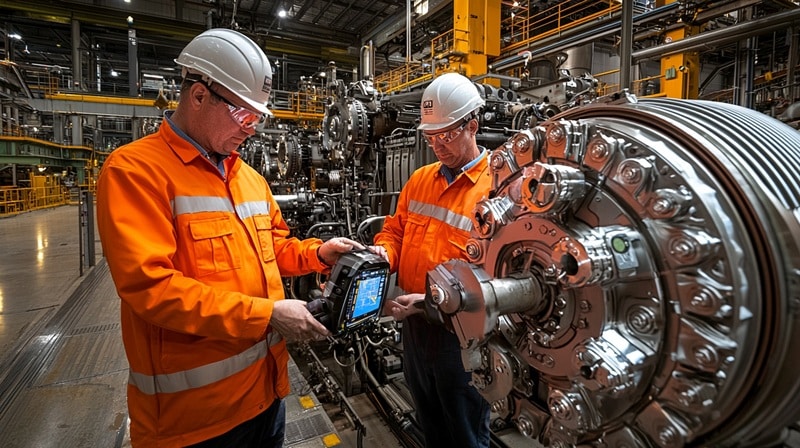
The evolution of maintenance strategies is inseparable from technological advances. Today, manufacturers rely in particular on:
- smart, connected sensors,
- industrial data management platforms,
- advanced analysis and decision support tools,
- next-generation CMMS systems,
- solutions to assist with field operations.
These technologies make processes more reliable, secure critical facilities, and sustainably improve industrial performance.
Maintenance, a key factor in overall performance
In the process industry, maintenance is no longer limited to a cost-based approach. It contributes directly to:
- production continuity,
- the safety of people and facilities,
- energy consumption control,
- the durability of equipment.
It is now at the heart of industrial strategies.
AMEG Group support
Beyond technological choices, the success of a maintenance strategy depends above all on its adoption by field teams.
AMEG Group supports manufacturers by translating maintenance challenges into concrete, operational solutions: audits of existing practices, analysis of equipment and failure modes, definition of strategies tailored to each type of maintenance.
The teams also design clear, structured, and secure support materials for machine operators, operators, and maintenance experts. These materials are tailored to each individual's level of authorization, ensuring that everyone has the information and instructions relevant to their scope of action. This differentiated approach makes interventions more reliable, standardizes practices, and secures installations, while transforming maintenance into a real lever for sustainable performance.
See also
Kintana ILTIS | 2026 French Lead Climbing Championships
A few days before the 2026 French Lead Climbing Championships, Kintana ILTIS shared her state of mind, her doubts, her progress, and her ambitions with us. Today, we invite you to read this account, written just before the competition.
Read more
Team AMEG Sport Welcomes Two New Athletes
Team AMEG Sport welcomes two new elite athletes to join Triomphe Collectif: Alice Marceau, a para-alpine skiing specialist, and Perrine Gindre, a rising star in French ski mountaineering. Two inspiring journeys driven by the values of perseverance, resilience, and pushing one’s limits.
Read more